Key Takeaways
Patents give you time-limited, country-by-country rights to stop others from using your technical invention, in return for publicly explaining how it works. For founders, engineers, and CEOs, a smart patent strategy across the US and Europe can protect core technology, support fundraising, and reduce the risk of being blocked or copied.
Key points:
- A patent protects only the technical features defined in its claims, not vague ideas, brands, or pure design, and it is always territorial.
- To be patentable in the US and Europe, an invention must be new, non-obvious, and useful, with a clear and complete description.
- Public disclosure before filing is especially risky in Europe, where there is almost no grace period, so you should plan filings before launches, fairs, or publications.
- US and European systems differ on software, business methods, and grace periods, so coordinated filing strategy within 12 months is vital if you want both markets.
- Ongoing work after grant—renewals, monitoring, and enforcement—is needed to turn patents into real business value, not just framed certificates.
Shield Your Innovation: The Golden Rules of Patenting
A patent provides a time-limited legal shield to protect concrete technical innovations in specific markets, transforming R&D into a strategic business asset. However, securing effective patent protection requires navigating strict legal standards (novelty, non-obviousness, and usefulness) and stark regulatory differences between regions—most notably the lack of a grace period in Europe compared to the US. Developing a strong patent position requires rigorous internal processes, strategic alignment with market revenue, and early collaboration with patent experts to avoid permanent, costly mistakes.
The Core Rules: Patents protect defined technical solutions, not vague ideas. To qualify, an invention must be completely new, non-obvious, and useful.
The “File First” Imperative: Because Europe lacks a grace period for prior disclosure, any early public demo, launch, or publication can permanently destroy your patent options there.
Strategic Alignment: A random patent portfolio wastes money. Maintain value by actively pruning non-useful rights, mapping patents directly to your product roadmap, and focusing budgets only on key markets.
Expert Execution: Avoid DIY drafting or late-stage fixes. Involve a skilled patent attorney before your first filing to craft robust claims that withstand competitor challenges.
Proactive Risk Management: Implement strict internal routines, use Non-Disclosure Agreements (NDAs), and track multi-country maintenance and renewal deadlines on a centralized calendar to prevent accidental loss of rights.
What is a Patent? The Ultimate Guide to US & European Patent Protection
Patents are legal rights that let you stop others from using your invention for a limited time, in a specific country or region. In plain words, a patent is a government-issued shield for your invention, in exchange for you explaining to the public how it works.
For founders, engineers, and CEOs, this shield can be the difference between leading a market and getting copied on day one. Understanding intellectual property rights helps you make smarter business decisions.
We work with innovators every day to:
- Build a patent strategy that fits their business plan.
- Draft and file patents in the US, Europe, and internationally.
- Manage portfolios, renewals, and enforcement over many years.
We often meet clients who say, “I think I know what a patent means, but I am not sure how to protect my invention in both the US and Europe.” This guide answers that, in simple language.
What Patent Means in Simple Terms
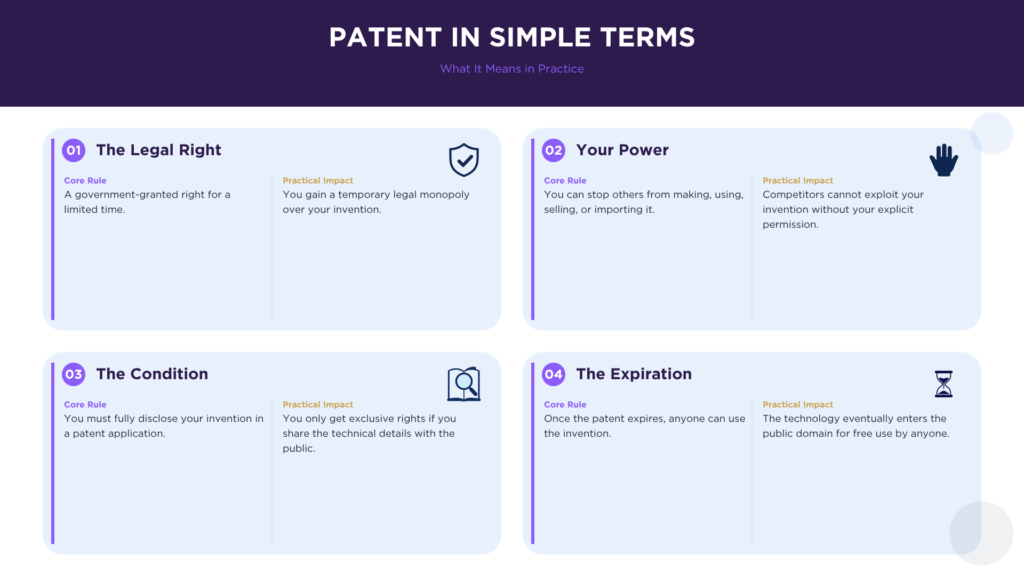
A patent is a legal right granted by a government for a limited time. In practice:
- You can stop others from making, using, selling, or importing your invention without your permission in that country.
- You get this right only if you disclose your invention in a patent application.
- After the patent expires, anyone can use the invention.
According to the University of Iowa library guide, a patent is the right to exclude others from making, using, offering for sale, selling, or importing the invention in the issuing country, not the right to practice it yourself.
When you wonder what a patent protects, think about:
- The structure of your product.
- The steps of your process.
- The composition of your material or formula.
- In some cases, specific uses of a known product.
)
Why a Patent is Important for Your Business
Analysing why patent is important, it is far more than a legal document; it is a vital business tool that directly drives revenue, manages risk, and fuels growth. For startups and SMEs, a strong patent creates a distinct competitive advantage by keeping copycats away while giving you the legal leverage to block competitors, negotiate licenses, and attract investors during M&A or funding rounds.
Conversely, leaving your innovation unprotected introduces severe risks. A competitor might file first and block your product entirely, or you could permanently lose the right to commercialize in key markets—especially in Europe, where public disclosure before filing destroys patentability. Relying solely on trade secrets also makes enforcement incredibly difficult.
Many founders skip the patent process to save money, only to face devastating competitor blocks years later. With early expert guidance to identify exactly what to protect, these companies could have secured their key features from day one. At Metida, we help clients strategically plan their patents filings to build a cohesive, valuable portfolio that investors respect.
What is Patent Law and How Does It Work?
Patent law is the specific branch of intellectual property law that governs what qualifies for protection, how an inventor obtains a patent, and how long those exclusive rights last. In legal terms, it dictates exactly what a patent protects and establishes the rules for enforcing, licensing, or assigning those rights to others. Because patent law is strictly national or regional, its rules apply only within specific borders; for example, US patent law governs US patents, while European patent law covers patents granted by the European Patent Office alongside the national laws of individual European countries. On a global scale, the World Intellectual Property Organization (WIPO) oversees the international frameworks that help connect these separate systems. Learn more about modern IP law and how it affects your inventions.
At its core, patent law is designed to strike a delicate balance between private interests and the public good. It drives progress by rewarding inventors with a temporary commercial monopoly, ensuring they can profit from their research and development without immediate competition. In return for this protection, the law requires inventors to fully disclose their technical details to the world. This ensures that society benefits as a whole, allowing others to learn from the technology and freely build upon it once the patent eventually expires.What does a patent protect and what it does not protect
What a Patent Protects and What It Does Not
What a patent protects
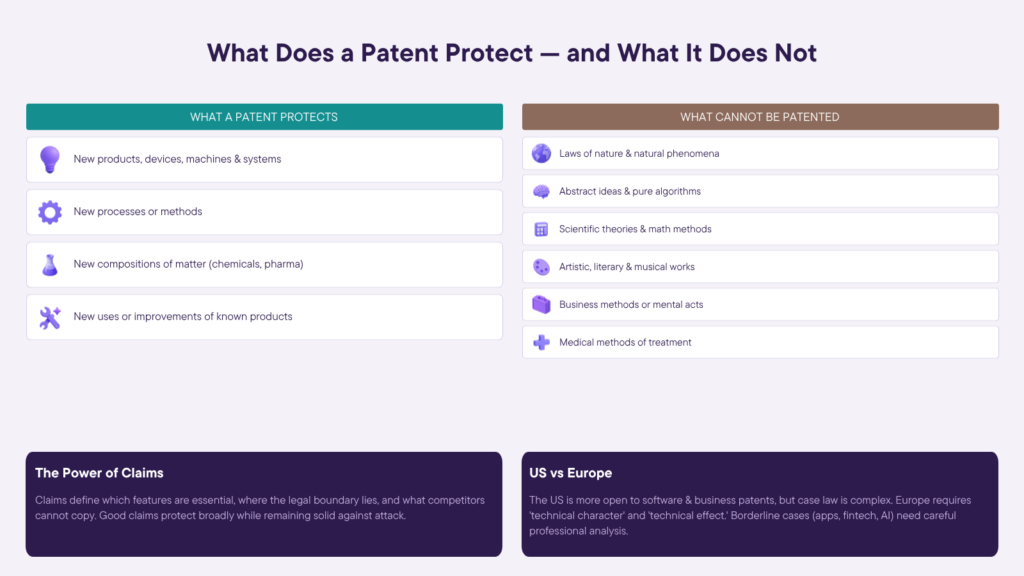
In both the US and Europe, what does a patent protect is mainly technical inventions, for example:
- New products, devices, machines, and systems
- New processes or methods of making or using something
- New compositions of matter, such as chemicals, materials, pharmaceuticals
- New uses or improvements of known products
The exact legal scope of what does a patent protect is set by the “claims” at the end of a patent. These claims define:
- Which features are essential
- Where the legal boundary of the invention lies
- What competitors cannot copy without risk
When we draft for clients at Metida, we spend a lot of time on claims, because this is where what patent means in real business terms is decided. Good claims can protect patent rights broadly but still be solid against attack.
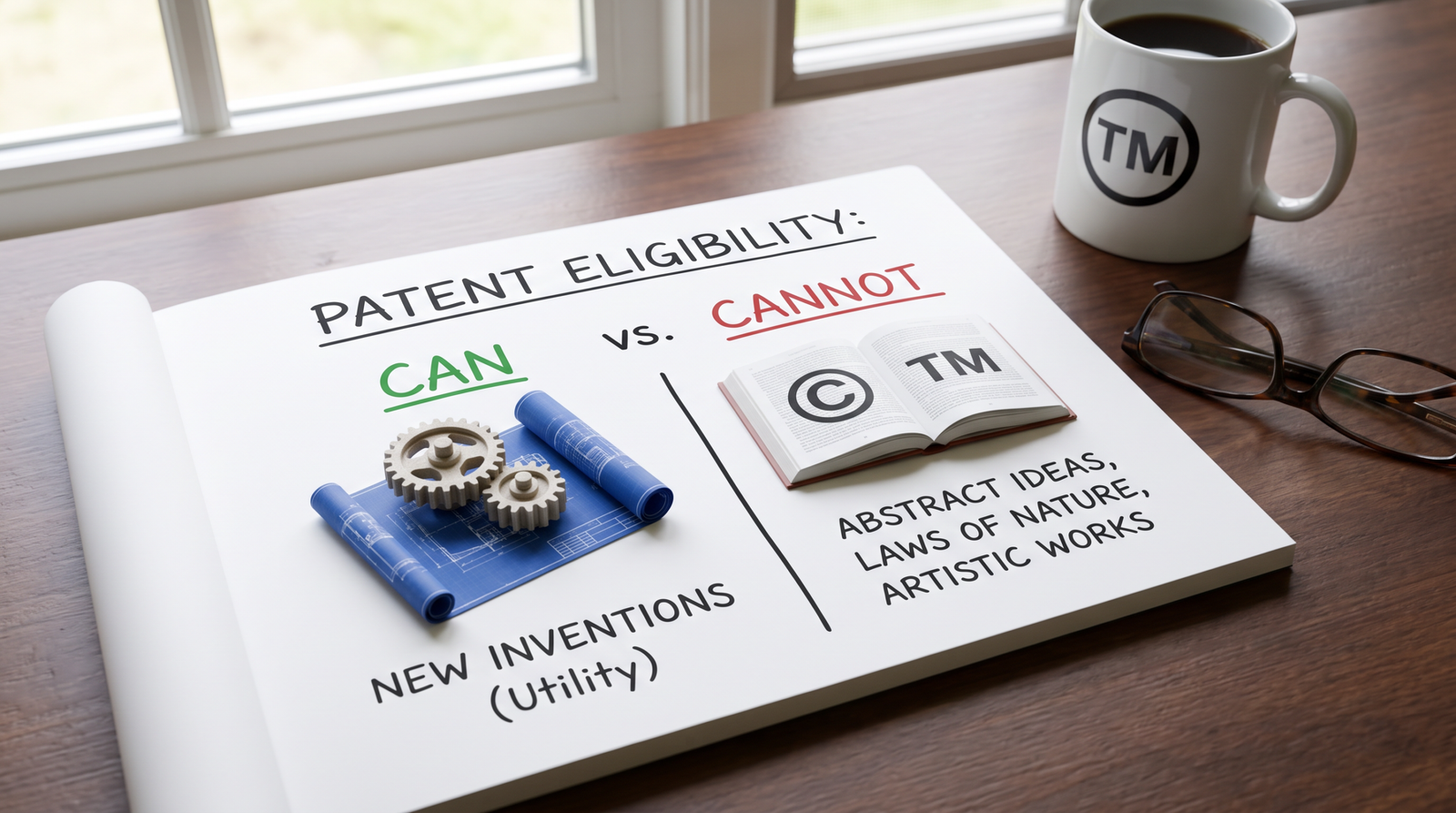
What cannot be patented
There are limits. What cannot be patented in the US and Europe, in general, includes:
- Laws of nature and natural phenomena
- Abstract ideas and pure algorithms with no technical effect
- Scientific theories and mathematical methods as such
- Artistic, literary, musical works, these are usually protected by copyright
- Business methods or mental acts as such, especially in Europe
- Medical methods of treatment on the human or animal body in many jurisdictions
Here, US patent law vs Europe is different. The US can be more open to software and business‑related patents, but case law is complex. Europe requires “technical character” and “technical effect,” especially for software, AI, and business methods, as the EPO explains in its guides on what patents protect.
Borderline cases, like apps, fintech tools, or AI models, need careful analysis. This is where professional input is vital to understand what does a patent protect in your specific technology.
)
Types of Patents
Main US patent types
Utility patent
– Protects how an invention works or is used, for processes, machines, compositions, and improvements
– This is the most common patent type
– Usually lasts up to 20 years from the filing date, if maintenance fees are paid.
Design patent
– Protects the ornamental design or appearance of an article, not how it works
– Term is usually 15 years from grant for newer US design patents
Plant patent
– Protects new, distinct plant varieties that are asexually reproduced
Clients also hear about a “provisional patent application.” This is not a separate patent type, but a filing tool in US patent law:
- A provisional patent application gives a filing date and allows you to say “patent pending”
- It never becomes a patent on its own
- You must file a non‑provisional utility patent within 12 months to protect patent rights based on that date
In casual talk, people treat “provisional” as one of the patent synonyms, but in law it is just a special application format.
European patent protection types
- In Europe, a patent is similar to a US utility patent. Main routes are:European patent via the European Patent Office (EPO)– One central examination- After grant, it becomes a “bundle” of national patents in chosen countries- The EPO describes this route in its basic guides. o read more about this standard framework, you can review the official European patent criteria.National patents via individual national offices, such as Germany, France, etc.Design protection in Europe is separate. Instead of a “design patent,” you have registered Community designs or national designs that protect the appearance of products. Function is still covered by patents.In both systems, what patent means is very close for technical inventions, but the labels and procedures differ.
Core Patentability Requirements
To protect patent rights in the US and Europe, your invention must meet three main tests.
Novelty
To satisfy the requirement of novelty, an invention must be completely new, meaning it cannot have been publicly disclosed anywhere in the world before your official filing date. It is crucial to realize that even your own public disclosure can inadvertently destroy this novelty. While the US offers some flexibility with a 12-month grace period for your own public disclosures, Europe operates under very strict regulations and grants almost no grace period at all.
Inventive step / Non obviousness
To meet the requirement of an inventive step or non-obviousness, the invention must not represent an obvious modification or change to a person who is skilled in that specific technical field. Because of its subjective nature, proving this non-obviousness is often the single hardest part to successfully argue during the patent examination process.
Industrial applicability / Utility
To fulfill the requirement of industrial applicability or utility, the invention must possess a real, practical use. Furthermore, it must be fully capable of being physically manufactured or actively used within some type of industry.
On top of this, what is patent law requires:
- A clear and complete description, so a skilled person can carry it out
- In Europe, a technical character and technical effect, especially for software or business‑related inventions
Many know what patent means in theory, but not how to show novelty, non obviousness, and usefulness in their field.
The Patent Process Step by Step
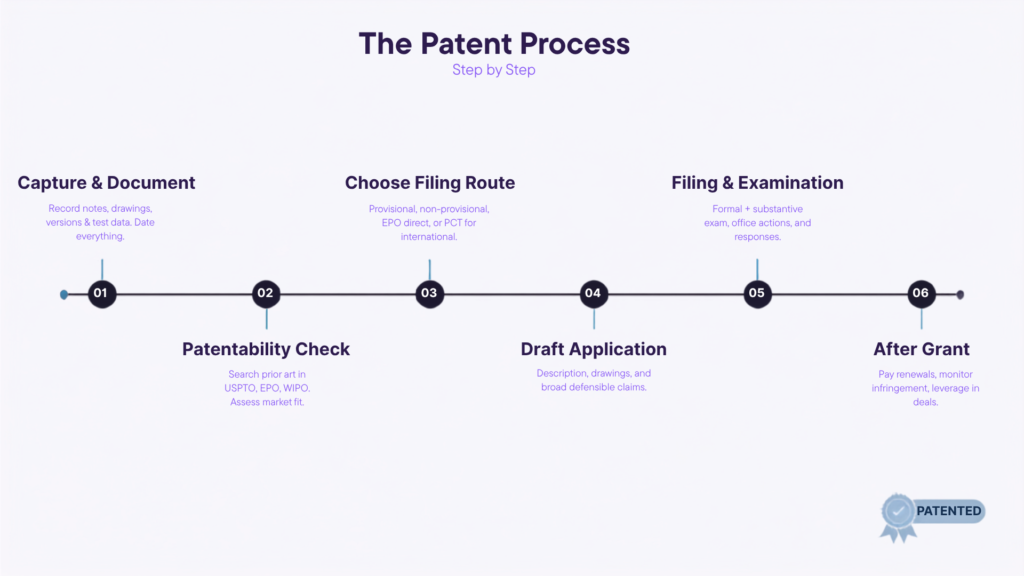
Step 1 – Capture and document your invention
First, record what you created.
- Keep notes, drawings, versions, and test data
- Date everything and store it safely
- Identify who contributed, this affects ownership
Good records support what patent means for your business later, especially if there are disputes.
Step 2 – Initial patentability and market check
Before filing, check if it is worth it.
- Search prior art in databases like USPTO, EPO, WIPO, Espacenet, and Google Patents
- Scan competitors and alternatives
- Think about market size, possible pricing, and life cycle
Many sources recommend this kind of search and market check as an early step.
Step 3 – Choose the right filing route
Next, pick the route that fits your strategy and budget.
- In the US
– Provisional patent application, cheaper, gives you a filing date
– Non‑provisional utility patent, starts full examination
- In Europe
– File directly at the EPO for a European patent
– Or file at a national office and possibly use that as a priority for later filings
- Internationally
– Use the PCT route to keep options open in many countries
Step 4 – Drafting the patent application
This step defines what does a patent protect.
A strong application includes:
- A detailed description that explains the invention and variations
- Drawings where they help understanding
- Carefully drafted claims that are as broad as possible but still defensible
Many DIY applications fail because they do not clearly state what patent means in claim language.
Step 5 – Filing and examination
After drafting, you file at the relevant office:
- US, at the USPTO
- Europe, at the EPO or national office
The process usually includes:
- Formal examination, to check documents, fees, and basic rules
- Substantive examination, to check novelty, inventive step, and usefulness
- Office actions, where the examiner raises objections
- Responses, where your attorney argues, amends claims, and sometimes narrows scope
The USPTO gives a clear overview of this process.
Outcomes can be:
- Grant of a patent
- Final rejection, sometimes appealable
- Abandonment, if fees or responses are not filed
We handle office actions and strategy for our clients, so they do not have to interpret each objection alone.
Step 6 – After grant
When the patent is granted, work is not over.
- Pay maintenance or renewal fees on time, in each country
- Monitor competitors and markets for possible infringement
- Use the patent in deals, licensing, cross‑licensing, or as leverage in disputes
As several strategy guides note, maintaining and monitoring patents is key to real value.
Proactive oversight ensures you mitigate intellectual property violations risks prevention and legal help parameters before competitor copycats can impact your market revenue.
)
What are the basics of US patent law?
In the United States, the primary authority is the USPTO. For founders navigating the system, the core fundamentals include:
- First Inventor to File: Rights typically go to the first person to file the application, not the first person to invent.
- Patent Lifespans: Utility patents last up to 20 years from the earliest filing date, while design patents last 15 years from the grant date.
- Grace Period: A 12-month grace period exists after your own public disclosure, but relying on it is highly risky.
- Provisional Applications: These function as a low-cost first step to secure an early filing date.
The USPTO conducts a substantive examination involving official office actions, allowing you to amend your application during prosecution.
If infringement occurs, enforcement in the US takes place through civil lawsuits in federal courts to pursue financial damages or injunctions. Ultimately, a patent only protects what is explicitly written in the granted claims as interpreted by the court, making high-quality drafting essential.
How Does European patent law differ from the US?
European patent law offers two main pathways: you can file one application through the European Patent Office (EPO) for a single examination, or apply directly to individual national offices. If you choose the EPO route, your granted patent must be validated in your selected countries, where it then acts just like a local national patent.
Compared to the US, Europe has much stricter rules on what qualifies for protection and how prior disclosure is treated:
- Strict Novelty & Technical Focus: There is almost no grace period for an inventor’s own public disclosure before filing. Additionally, inventions must show a clear technical character and effect, which is especially critical for software and business methods.
- Lifespan & Fees: Patents typically last 20 years from the filing date, but you must pay yearly renewal fees to every individual country where you validate the patent.
Enforcement is still handled mainly by individual national courts. A new Unified Patent Court system is rolling out for certain “unitary patents,” but because the details are complex and still developing, you should plan your strategy country by country.
How Does European patent law differ from the US?
)
Subject matter eligibility
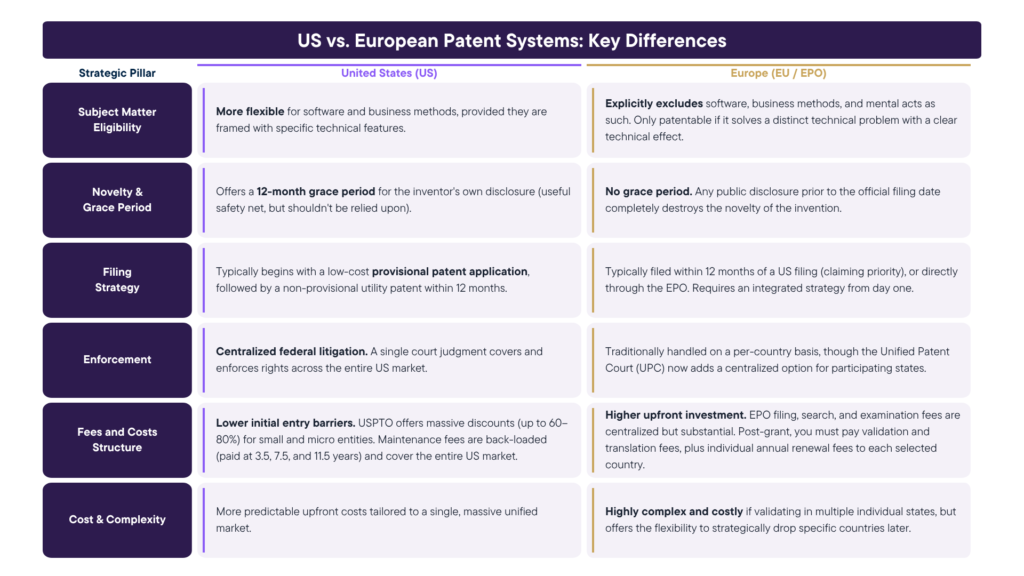
In the United States, the patent system is more flexible regarding software and business-related inventions, although the case law surrounding abstract ideas remains complex. Despite these complexities, many software inventions are still entirely possible to protect if they are properly framed with specific technical features. Conversely, Europe explicitly excludes software, business methods, and mental acts as such from standard patentability. However, the European framework still allows for software and AI patents, provided that the invention delivers a clear technical effect or solves a distinct technical problem.[source]
Novelty and grace period
The United States provides a 12-month grace period for the inventor’s own disclosure. While this is certainly better than nothing, it is not a safety net that you should actively rely on. In contrast, Europe offers almost no grace period at all, meaning that any public disclosure made before your official filing date can completely destroy the novelty of the invention. This stark contrast alone is a strong reason why understanding why patent is important is vital to planning your patent strategy before diving into marketing, attending trade fairs, or releasing publications, especially if you want protection in Europe.
Filing strategy
When considering a filing strategy in the United States, a common pattern is to first submit a provisional patent application, followed later by a non-provisional utility patent. This approach offers a low cost to start, though it requires that the patent claims be properly supported at a later stage. In Europe, you will often file after a first US filing while claiming priority, or you can choose to start directly at the EPO or a European national office. To navigate these choices, we often help clients plan a combined US and Europe route, which involves making a first filing in one system and then expanding within 12 months under international rules.
Enforcement
In the United States, the process relies on central federal litigation, which means that a single judgment has the power to cover the entire US market. In contrast, enforcement in Europe is usually handled on a per-country basis. However, the introduction of the Unified Patent Court adds a helpful central layer for certain patents, while simultaneously introducing more strategic choices –for businesses to consider.
Fees and Cost Structure
The financial commitment required to secure a patent highlights another major divergence between the USPTO and the EPO frameworks. The United States offers a significantly lower entry barrier for startups and individual inventors, as the USPTO provides substantial fee discounts (up to 60% for Small Entities and 80% for Micro Entities) on filing, search, and examination. Furthermore, US maintenance fees are back-loaded—paid only at 3.5, 7.5, and 11.5 years post-grant—covering the entire nation under a single fee structure. In contrast, the European route requires a heavy upfront investment. While the EPO centralizes the filing and examination fees, the true financial burden arises after the patent is granted. Inventors must then pay validation fees, handle mandatory local translation costs, and maintain the patent by paying individual, escalating annual renewal fees to every single European country where protection is maintained.
Cost and complexity
The total cost of a patent depends on several factors, including the quality of drafting, the overall number of countries involved, required translations and local agent fees, as well as the years of renewals. Navigating Europe can become notably more complex and costly when you choose to validate the patent in many individual states; however, it also offers more flexibility, allowing you to strategically drop specific countries as your markets change. Ultimately, the true purpose of a patent as a business tool is to protect your key markets, which is why we advise clients to think with an integrated mindset rather than falling into the trap of a “US first, Europe someday” approach.
How to Build a Practical Patent Strategy
A patent strategy is not “file everything.” It is about deciding what to protect, where, and when, based on your business plan.
We usually guide clients through these steps.
Decide what really needs patent protection
Ask yourself:
- Which technologies are core to our product or service
- Which features will competitors most likely copy
- Which inventions support our long term positioning
Here, understanding what does a patent protect is key. Sometimes a single patent can cover a whole family of products. Sometimes you need several patents for different modules. Learn more about IP due diligence.
Align with business goals
To effectively align with business goals, your overall patent plan needs to closely match your market entry timing and product roadmap, your investor expectations and future fundraising, as well as your specific licensing or joint venture plans. For many startups, why a patent is important comes down to the fact that investors routinely expect a clear IP story. Because of this, maintaining a focused set of strong patents is often significantly better than pursuing many weak filings.
Choose where to protect
Because patent protection is territorial, you must specifically select the countries in which you want coverage. When deciding, typical priorities should include your main sales markets, the locations where you manufacture your products, the countries where your key competitors operate, and any regions that are particularly important for your investors or strategic partners. Keep in mind that a European patent with validation in just 5 to 10 key states can often protect the vast majority of your EU revenue.
Manage your patent portfolio
Once you start filing regularly, you have a portfolio to manage.
- Review applications and granted patents regularly
- Abandon patents that no longer fit your products or markets
- Consider defensive publications where patenting is not ideal
Good portfolio management keeps your protected patent budget under control and your rights aligned with business reality.
What are the most common patent mistakes to avoid?
Public Disclosure: Posting online, presenting at trade fairs, or pitching without an NDA before filing completely destroys your novelty—which is especially fatal under Europe’s strict rules.
Global Assumptions: Patent rights are strictly territorial. A single patent never covers the entire world; you must protect your IP country by country or via regional systems.
Lacking Technical Detail: Patent law only protects specific, concrete technical solutions, not standalone business concepts or bare ideas.
Filing Without Experts: Independent filings often result in weak claims and poor descriptions that are incredibly difficult to enforce and usually impossible to fix later.
Skipping Maintenance: Missing mandatory renewal fees will instantly kill an active patent, while failing to monitor competitors allows infringement to grow completely unnoticed.
Bypassing these costly traps is exactly why patent is important to consider early with expert support.
How Metida helps you protect your invention
We keep our communication simple and clear, even when the law is complex. Our goal is to turn what is patent law and what does the patent protect into plain, useful advice for your business. Take a contact with us.
Frequently Asked Questions (FAQ)
1. Can I protect my software or AI product with a patent?
It depends on your jurisdiction. See our insights on safely using AI for patents. In the US, the system is more flexible, allowing software patents if they are framed around specific technical features rather than abstract ideas. In Europe, software and AI as such are explicitly excluded from patentability. However, you can still secure a European patent if you can prove your software delivers a clear technical effect or solves a concrete, practical technical problem.
2. What happens if I present at a trade fair before filing a patent?
If you plan to expand to Europe, doing this can be fatal. Europe operates under a strict “absolute novelty” rule with virtually no grace period—any public disclosure before your official filing date destroys your chances of getting a patent. The US does offer a 12-month grace period for the inventor’s own disclosures, but relying on it is highly risky and will still lock you out of the European market. Always file at least a provisional application before any public reveal.
3. How much do USPTO and EPO patents cost, and are there any discounts?
Costs vary by jurisdiction. You can use our UP Estimator if considering European unitary protection. The US (USPTO) has a lower financial barrier to entry because it offers massive government fee discounts to support smaller innovators—up to 60% off for Small Entities (startups) and 80% off for Micro Entities (individual inventors). Europe (EPO) requires a much higher upfront investment. While the initial examination is centralized, the real costs spike after the patent is granted, as you must pay validation fees, translation costs, and escalating annual renewal fees to every individual European country you want coverage in.
4. What is the difference between a provisional and a non-provisional patent application in the US?
A provisional application is a quick, low-cost filing tool unique to the US system. It secures your priority date and allows you to legally use the term “patent pending” for 12 months, but it never automatically turns into a granted patent. To actually get a patent, you must file a full, detailed non-provisional utility patent application within that 12-month window, properly supporting all your technical claims.
5. If I get a granted European patent, does it protect me across the entire EU automatically?
No. A standard European patent granted by the EPO acts as a “bundle” of national rights. After it is approved, you must specifically choose (“validate”) which European countries you want to protect your technology in and pay fees accordingly. While the new Unified Patent Court (UPC) introduces a more centralized system for certain participating states, you still need a country-by-country strategy based on your key revenue markets to keep costs manageable.
Conclusion
Establishing an early intellectual property roadmap directly impacts a company’s financial valuation and long-term security. Evaluating why patent is important allows founders to confidently secure essential fundraising, secure market territory, and safeguard innovations from day-one copycats. When drafting claims, knowing exactly what does the patent protect guarantees that a business can enforce its rights against specific competitor infringements. Navigating the legal discrepancies between the US and European systems safely avoids irreversible errors like premature public disclosures. Ultimately, combining expert legal precision with your corporate roadmap transforms complex regulations into a reliable commercial shield. If you are ready to start, please contact our team to discuss your specific needs.
Key Takeaways
Patents give you time-limited, country-by-country rights to stop others from using your technical invention, in return for publicly explaining how it works. For founders, engineers, and CEOs, a smart patent strategy across the US and Europe can protect core technology, support fundraising, and reduce the risk of being blocked or copied.
Key points:
- A patent protects only the technical features defined in its claims, not vague ideas, brands, or pure design, and it is always territorial.
- To be patentable in the US and Europe, an invention must be new, non-obvious, and useful, with a clear and complete description.
- Public disclosure before filing is especially risky in Europe, where there is almost no grace period, so you should plan filings before launches, fairs, or publications.
- US and European systems differ on software, business methods, and grace periods, so coordinated filing strategy within 12 months is vital if you want both markets.
- Ongoing work after grant—renewals, monitoring, and enforcement—is needed to turn patents into real business value, not just framed certificates.
Shield Your Innovation: The Golden Rules of Patenting
A patent provides a time-limited legal shield to protect concrete technical innovations in specific markets, transforming R&D into a strategic business asset. However, securing effective patent protection requires navigating strict legal standards (novelty, non-obviousness, and usefulness) and stark regulatory differences between regions—most notably the lack of a grace period in Europe compared to the US. Developing a strong patent position requires rigorous internal processes, strategic alignment with market revenue, and early collaboration with patent experts to avoid permanent, costly mistakes.
The Core Rules: Patents protect defined technical solutions, not vague ideas. To qualify, an invention must be completely new, non-obvious, and useful.
The “File First” Imperative: Because Europe lacks a grace period for prior disclosure, any early public demo, launch, or publication can permanently destroy your patent options there.
Strategic Alignment: A random patent portfolio wastes money. Maintain value by actively pruning non-useful rights, mapping patents directly to your product roadmap, and focusing budgets only on key markets.
Expert Execution: Avoid DIY drafting or late-stage fixes. Involve a skilled patent attorney before your first filing to craft robust claims that withstand competitor challenges.
Proactive Risk Management: Implement strict internal routines, use Non-Disclosure Agreements (NDAs), and track multi-country maintenance and renewal deadlines on a centralized calendar to prevent accidental loss of rights.
What is a Patent? The Ultimate Guide to US & European Patent Protection
Patents are legal rights that let you stop others from using your invention for a limited time, in a specific country or region. In plain words, a patent is a government-issued shield for your invention, in exchange for you explaining to the public how it works.
For founders, engineers, and CEOs, this shield can be the difference between leading a market and getting copied on day one. Understanding intellectual property rights helps you make smarter business decisions.
We work with innovators every day to:
- Build a patent strategy that fits their business plan.
- Draft and file patents in the US, Europe, and internationally.
- Manage portfolios, renewals, and enforcement over many years.
We often meet clients who say, “I think I know what a patent means, but I am not sure how to protect my invention in both the US and Europe.” This guide answers that, in simple language.
What Patent Means in Simple Terms
A patent is a legal right granted by a government for a limited time. In practice:
- You can stop others from making, using, selling, or importing your invention without your permission in that country.
- You get this right only if you disclose your invention in a patent application.
- After the patent expires, anyone can use the invention.
According to the University of Iowa library guide, a patent is the right to exclude others from making, using, offering for sale, selling, or importing the invention in the issuing country, not the right to practice it yourself.
When you wonder what a patent protects, think about:
- The structure of your product.
- The steps of your process.
- The composition of your material or formula.
- In some cases, specific uses of a known product.
)
Why a Patent is Important for Your Business
Analysing why patent is important, it is far more than a legal document; it is a vital business tool that directly drives revenue, manages risk, and fuels growth. For startups and SMEs, a strong patent creates a distinct competitive advantage by keeping copycats away while giving you the legal leverage to block competitors, negotiate licenses, and attract investors during M&A or funding rounds.
Conversely, leaving your innovation unprotected introduces severe risks. A competitor might file first and block your product entirely, or you could permanently lose the right to commercialize in key markets—especially in Europe, where public disclosure before filing destroys patentability. Relying solely on trade secrets also makes enforcement incredibly difficult.
Many founders skip the patent process to save money, only to face devastating competitor blocks years later. With early expert guidance to identify exactly what to protect, these companies could have secured their key features from day one. At Metida, we help clients strategically plan their patents filings to build a cohesive, valuable portfolio that investors respect.
What is Patent Law and How Does It Work?
Patent law is the specific branch of intellectual property law that governs what qualifies for protection, how an inventor obtains a patent, and how long those exclusive rights last. In legal terms, it dictates exactly what a patent protects and establishes the rules for enforcing, licensing, or assigning those rights to others. Because patent law is strictly national or regional, its rules apply only within specific borders; for example, US patent law governs US patents, while European patent law covers patents granted by the European Patent Office alongside the national laws of individual European countries. On a global scale, the World Intellectual Property Organization (WIPO) oversees the international frameworks that help connect these separate systems. Learn more about modern IP law and how it affects your inventions.
At its core, patent law is designed to strike a delicate balance between private interests and the public good. It drives progress by rewarding inventors with a temporary commercial monopoly, ensuring they can profit from their research and development without immediate competition. In return for this protection, the law requires inventors to fully disclose their technical details to the world. This ensures that society benefits as a whole, allowing others to learn from the technology and freely build upon it once the patent eventually expires.What does a patent protect and what it does not protect
What a Patent Protects and What It Does Not
What a patent protects
In both the US and Europe, what does a patent protect is mainly technical inventions, for example:
- New products, devices, machines, and systems
- New processes or methods of making or using something
- New compositions of matter, such as chemicals, materials, pharmaceuticals
- New uses or improvements of known products
The exact legal scope of what does a patent protect is set by the “claims” at the end of a patent. These claims define:
- Which features are essential
- Where the legal boundary of the invention lies
- What competitors cannot copy without risk
When we draft for clients at Metida, we spend a lot of time on claims, because this is where what patent means in real business terms is decided. Good claims can protect patent rights broadly but still be solid against attack.
What cannot be patented
There are limits. What cannot be patented in the US and Europe, in general, includes:
- Laws of nature and natural phenomena
- Abstract ideas and pure algorithms with no technical effect
- Scientific theories and mathematical methods as such
- Artistic, literary, musical works, these are usually protected by copyright
- Business methods or mental acts as such, especially in Europe
- Medical methods of treatment on the human or animal body in many jurisdictions
Here, US patent law vs Europe is different. The US can be more open to software and business‑related patents, but case law is complex. Europe requires “technical character” and “technical effect,” especially for software, AI, and business methods, as the EPO explains in its guides on what patents protect.
Borderline cases, like apps, fintech tools, or AI models, need careful analysis. This is where professional input is vital to understand what does a patent protect in your specific technology.
)
Types of Patents
Main US patent types
Utility patent
– Protects how an invention works or is used, for processes, machines, compositions, and improvements
– This is the most common patent type
– Usually lasts up to 20 years from the filing date, if maintenance fees are paid.
Design patent
– Protects the ornamental design or appearance of an article, not how it works
– Term is usually 15 years from grant for newer US design patents
Plant patent
– Protects new, distinct plant varieties that are asexually reproduced
Clients also hear about a “provisional patent application.” This is not a separate patent type, but a filing tool in US patent law:
- A provisional patent application gives a filing date and allows you to say “patent pending”
- It never becomes a patent on its own
- You must file a non‑provisional utility patent within 12 months to protect patent rights based on that date
In casual talk, people treat “provisional” as one of the patent synonyms, but in law it is just a special application format.
European patent protection types
In Europe, a patent is similar to a US utility patent. Main routes are:European patent via the European Patent Office (EPO)– One central examination- After grant, it becomes a “bundle” of national patents in chosen countries- The EPO describes this route in its basic guides. o read more about this standard framework, you can review the official European patent criteria.National patents via individual national offices, such as Germany, France, etc.Design protection in Europe is separate. Instead of a “design patent,” you have registered Community designs or national designs that protect the appearance of products. Function is still covered by patents.In both systems, what patent means is very close for technical inventions, but the labels and procedures differ.
Core Patentability Requirements
To protect patent rights in the US and Europe, your invention must meet three main tests.
Novelty
To satisfy the requirement of novelty, an invention must be completely new, meaning it cannot have been publicly disclosed anywhere in the world before your official filing date. It is crucial to realize that even your own public disclosure can inadvertently destroy this novelty. While the US offers some flexibility with a 12-month grace period for your own public disclosures, Europe operates under very strict regulations and grants almost no grace period at all.
Inventive step / Non obviousness
To meet the requirement of an inventive step or non-obviousness, the invention must not represent an obvious modification or change to a person who is skilled in that specific technical field. Because of its subjective nature, proving this non-obviousness is often the single hardest part to successfully argue during the patent examination process.
Industrial applicability / Utility
To fulfill the requirement of industrial applicability or utility, the invention must possess a real, practical use. Furthermore, it must be fully capable of being physically manufactured or actively used within some type of industry.
On top of this, what is patent law requires:
- A clear and complete description, so a skilled person can carry it out
- In Europe, a technical character and technical effect, especially for software or business‑related inventions
Many know what patent means in theory, but not how to show novelty, non obviousness, and usefulness in their field.
The Patent Process Step by Step
Step 1 – Capture and document your invention
First, record what you created.
- Keep notes, drawings, versions, and test data
- Date everything and store it safely
- Identify who contributed, this affects ownership
Good records support what patent means for your business later, especially if there are disputes.
Step 2 – Initial patentability and market check
Before filing, check if it is worth it.
- Search prior art in databases like USPTO, EPO, WIPO, Espacenet, and Google Patents
- Scan competitors and alternatives
- Think about market size, possible pricing, and life cycle
Many sources recommend this kind of search and market check as an early step.
Step 3 – Choose the right filing route
Next, pick the route that fits your strategy and budget.
- In the US
– Provisional patent application, cheaper, gives you a filing date
– Non‑provisional utility patent, starts full examination
- In Europe
– File directly at the EPO for a European patent
– Or file at a national office and possibly use that as a priority for later filings
- Internationally
– Use the PCT route to keep options open in many countries
Step 4 – Drafting the patent application
This step defines what does a patent protect.
A strong application includes:
- A detailed description that explains the invention and variations
- Drawings where they help understanding
- Carefully drafted claims that are as broad as possible but still defensible
Many DIY applications fail because they do not clearly state what patent means in claim language.
Step 5 – Filing and examination
After drafting, you file at the relevant office:
- US, at the USPTO
- Europe, at the EPO or national office
The process usually includes:
- Formal examination, to check documents, fees, and basic rules
- Substantive examination, to check novelty, inventive step, and usefulness
- Office actions, where the examiner raises objections
- Responses, where your attorney argues, amends claims, and sometimes narrows scope
The USPTO gives a clear overview of this process.
Outcomes can be:
- Grant of a patent
- Final rejection, sometimes appealable
- Abandonment, if fees or responses are not filed
We handle office actions and strategy for our clients, so they do not have to interpret each objection alone.
Step 6 – After grant
When the patent is granted, work is not over.
- Pay maintenance or renewal fees on time, in each country
- Monitor competitors and markets for possible infringement
- Use the patent in deals, licensing, cross‑licensing, or as leverage in disputes
As several strategy guides note, maintaining and monitoring patents is key to real value.
Proactive oversight ensures you mitigate intellectual property violations risks prevention and legal help parameters before competitor copycats can impact your market revenue.
)
What are the basics of US patent law?
In the United States, the primary authority is the USPTO. For founders navigating the system, the core fundamentals include:
- First Inventor to File: Rights typically go to the first person to file the application, not the first person to invent.
- Patent Lifespans: Utility patents last up to 20 years from the earliest filing date, while design patents last 15 years from the grant date.
- Grace Period: A 12-month grace period exists after your own public disclosure, but relying on it is highly risky.
- Provisional Applications: These function as a low-cost first step to secure an early filing date.
The USPTO conducts a substantive examination involving official office actions, allowing you to amend your application during prosecution.
If infringement occurs, enforcement in the US takes place through civil lawsuits in federal courts to pursue financial damages or injunctions. Ultimately, a patent only protects what is explicitly written in the granted claims as interpreted by the court, making high-quality drafting essential.
How Does European patent law differ from the US?
European patent law offers two main pathways: you can file one application through the European Patent Office (EPO) for a single examination, or apply directly to individual national offices. If you choose the EPO route, your granted patent must be validated in your selected countries, where it then acts just like a local national patent.
Compared to the US, Europe has much stricter rules on what qualifies for protection and how prior disclosure is treated:
- Strict Novelty & Technical Focus: There is almost no grace period for an inventor’s own public disclosure before filing. Additionally, inventions must show a clear technical character and effect, which is especially critical for software and business methods.
- Lifespan & Fees: Patents typically last 20 years from the filing date, but you must pay yearly renewal fees to every individual country where you validate the patent.
Enforcement is still handled mainly by individual national courts. A new Unified Patent Court system is rolling out for certain “unitary patents,” but because the details are complex and still developing, you should plan your strategy country by country.
How Does European patent law differ from the US?
)
Subject matter eligibility
In the United States, the patent system is more flexible regarding software and business-related inventions, although the case law surrounding abstract ideas remains complex. Despite these complexities, many software inventions are still entirely possible to protect if they are properly framed with specific technical features. Conversely, Europe explicitly excludes software, business methods, and mental acts as such from standard patentability. However, the European framework still allows for software and AI patents, provided that the invention delivers a clear technical effect or solves a distinct technical problem.[source]
Novelty and grace period
The United States provides a 12-month grace period for the inventor’s own disclosure. While this is certainly better than nothing, it is not a safety net that you should actively rely on. In contrast, Europe offers almost no grace period at all, meaning that any public disclosure made before your official filing date can completely destroy the novelty of the invention. This stark contrast alone is a strong reason why understanding why patent is important is vital to planning your patent strategy before diving into marketing, attending trade fairs, or releasing publications, especially if you want protection in Europe.
Filing strategy
When considering a filing strategy in the United States, a common pattern is to first submit a provisional patent application, followed later by a non-provisional utility patent. This approach offers a low cost to start, though it requires that the patent claims be properly supported at a later stage. In Europe, you will often file after a first US filing while claiming priority, or you can choose to start directly at the EPO or a European national office. To navigate these choices, we often help clients plan a combined US and Europe route, which involves making a first filing in one system and then expanding within 12 months under international rules.
Enforcement
In the United States, the process relies on central federal litigation, which means that a single judgment has the power to cover the entire US market. In contrast, enforcement in Europe is usually handled on a per-country basis. However, the introduction of the Unified Patent Court adds a helpful central layer for certain patents, while simultaneously introducing more strategic choices –for businesses to consider.
Fees and Cost Structure
The financial commitment required to secure a patent highlights another major divergence between the USPTO and the EPO frameworks. The United States offers a significantly lower entry barrier for startups and individual inventors, as the USPTO provides substantial fee discounts (up to 60% for Small Entities and 80% for Micro Entities) on filing, search, and examination. Furthermore, US maintenance fees are back-loaded—paid only at 3.5, 7.5, and 11.5 years post-grant—covering the entire nation under a single fee structure. In contrast, the European route requires a heavy upfront investment. While the EPO centralizes the filing and examination fees, the true financial burden arises after the patent is granted. Inventors must then pay validation fees, handle mandatory local translation costs, and maintain the patent by paying individual, escalating annual renewal fees to every single European country where protection is maintained.
Cost and complexity
The total cost of a patent depends on several factors, including the quality of drafting, the overall number of countries involved, required translations and local agent fees, as well as the years of renewals. Navigating Europe can become notably more complex and costly when you choose to validate the patent in many individual states; however, it also offers more flexibility, allowing you to strategically drop specific countries as your markets change. Ultimately, the true purpose of a patent as a business tool is to protect your key markets, which is why we advise clients to think with an integrated mindset rather than falling into the trap of a “US first, Europe someday” approach.
How to Build a Practical Patent Strategy
A patent strategy is not “file everything.” It is about deciding what to protect, where, and when, based on your business plan.
We usually guide clients through these steps.
Decide what really needs patent protection
Ask yourself:
- Which technologies are core to our product or service
- Which features will competitors most likely copy
- Which inventions support our long term positioning
Here, understanding what does a patent protect is key. Sometimes a single patent can cover a whole family of products. Sometimes you need several patents for different modules. Learn more about IP due diligence.
Align with business goals
To effectively align with business goals, your overall patent plan needs to closely match your market entry timing and product roadmap, your investor expectations and future fundraising, as well as your specific licensing or joint venture plans. For many startups, why a patent is important comes down to the fact that investors routinely expect a clear IP story. Because of this, maintaining a focused set of strong patents is often significantly better than pursuing many weak filings.
Choose where to protect
Because patent protection is territorial, you must specifically select the countries in which you want coverage. When deciding, typical priorities should include your main sales markets, the locations where you manufacture your products, the countries where your key competitors operate, and any regions that are particularly important for your investors or strategic partners. Keep in mind that a European patent with validation in just 5 to 10 key states can often protect the vast majority of your EU revenue.
Manage your patent portfolio
Once you start filing regularly, you have a portfolio to manage.
- Review applications and granted patents regularly
- Abandon patents that no longer fit your products or markets
- Consider defensive publications where patenting is not ideal
Good portfolio management keeps your protected patent budget under control and your rights aligned with business reality.
What are the most common patent mistakes to avoid?
Public Disclosure: Posting online, presenting at trade fairs, or pitching without an NDA before filing completely destroys your novelty—which is especially fatal under Europe’s strict rules.
Global Assumptions: Patent rights are strictly territorial. A single patent never covers the entire world; you must protect your IP country by country or via regional systems.
Lacking Technical Detail: Patent law only protects specific, concrete technical solutions, not standalone business concepts or bare ideas.
Filing Without Experts: Independent filings often result in weak claims and poor descriptions that are incredibly difficult to enforce and usually impossible to fix later.
Skipping Maintenance: Missing mandatory renewal fees will instantly kill an active patent, while failing to monitor competitors allows infringement to grow completely unnoticed.
Bypassing these costly traps is exactly why patent is important to consider early with expert support.
How Metida helps you protect your invention
We keep our communication simple and clear, even when the law is complex. Our goal is to turn what is patent law and what does the patent protect into plain, useful advice for your business. Take a contact with us.
Frequently Asked Questions (FAQ)
1. Can I protect my software or AI product with a patent?
It depends on your jurisdiction. See our insights on safely using AI for patents. In the US, the system is more flexible, allowing software patents if they are framed around specific technical features rather than abstract ideas. In Europe, software and AI as such are explicitly excluded from patentability. However, you can still secure a European patent if you can prove your software delivers a clear technical effect or solves a concrete, practical technical problem.
2. What happens if I present at a trade fair before filing a patent?
If you plan to expand to Europe, doing this can be fatal. Europe operates under a strict “absolute novelty” rule with virtually no grace period—any public disclosure before your official filing date destroys your chances of getting a patent. The US does offer a 12-month grace period for the inventor’s own disclosures, but relying on it is highly risky and will still lock you out of the European market. Always file at least a provisional application before any public reveal.
3. How much do USPTO and EPO patents cost, and are there any discounts?
Costs vary by jurisdiction. You can use our UP Estimator if considering European unitary protection. The US (USPTO) has a lower financial barrier to entry because it offers massive government fee discounts to support smaller innovators—up to 60% off for Small Entities (startups) and 80% off for Micro Entities (individual inventors). Europe (EPO) requires a much higher upfront investment. While the initial examination is centralized, the real costs spike after the patent is granted, as you must pay validation fees, translation costs, and escalating annual renewal fees to every individual European country you want coverage in.
4. What is the difference between a provisional and a non-provisional patent application in the US?
A provisional application is a quick, low-cost filing tool unique to the US system. It secures your priority date and allows you to legally use the term “patent pending” for 12 months, but it never automatically turns into a granted patent. To actually get a patent, you must file a full, detailed non-provisional utility patent application within that 12-month window, properly supporting all your technical claims.
5. If I get a granted European patent, does it protect me across the entire EU automatically?
No. A standard European patent granted by the EPO acts as a “bundle” of national rights. After it is approved, you must specifically choose (“validate”) which European countries you want to protect your technology in and pay fees accordingly. While the new Unified Patent Court (UPC) introduces a more centralized system for certain participating states, you still need a country-by-country strategy based on your key revenue markets to keep costs manageable.
Conclusion
Establishing an early intellectual property roadmap directly impacts a company’s financial valuation and long-term security. Evaluating why patent is important allows founders to confidently secure essential fundraising, secure market territory, and safeguard innovations from day-one copycats. When drafting claims, knowing exactly what does the patent protect guarantees that a business can enforce its rights against specific competitor infringements. Navigating the legal discrepancies between the US and European systems safely avoids irreversible errors like premature public disclosures. Ultimately, combining expert legal precision with your corporate roadmap transforms complex regulations into a reliable commercial shield. If you are ready to start, please contact our team to discuss your specific needs.