Who Owns the Copyright to AI Art? A Complete Legal Guide for Creators and Businesses
Updated:
READ:
14 min.


As AI integration becomes standard in creative workflows, the question of ownership has shifted from „who used the tool” to „how much did the human do?” Use this summary to navigate the current legal landscape:
Who owns an AI-generated asset depends entirely on the level of human creative input. While pure machine output receives zero copyright protection, hybrid human-AI works can be legally protected if a real person adds enough original design work.
Understanding this distinction is essential for brand protection and commercial safety. Generative media is now deeply embedded in business workflows, with marketing teams regularly deploying it for:
The core issue is that many teams operate under dangerous misconceptions-either assuming that typing a text prompt grants them full ownership, or believing that AI art is always entirely free to use. In reality, relying on raw AI outputs means your brand risks using assets that lack legal exclusivity, or worse, unintentionally copying protected works and distinctive artist styles.
Key risks of misunderstanding AI art ownership:
To properly evaluate these risks, it helps to understand how traditional intellectual property frameworks view automated creation. In traditional artwork, the law protects the concrete, original expression of an idea rather than the abstract idea itself. This means you can copyright a unique drawing of a cat in a hat, but you cannot legally protect the general concept of animals wearing clothing, nor can you protect an artistic style or technique.
To secure standard copyright protection for any piece of art, three elements must coexist:
The core legal bottleneck in generative media is human authorship. In almost all major legal systems, copyright assumes a human creator. AI software packages are considered tools rather than authors, meaning the systems themselves cannot own rights.
To understand how copyright applies in daily practice, think of creation as a clear spectrum:
Research and policy bodies, including the U.S. Copyright Office, consistently reinforce a single foundational principle: copyright requires human creativity at its core, not just machine output driven by text prompts. A landmark early example: in the Zarya of the Dawn case (2023), the U.S. Copyright Office granted copyright only to the human-written text and the selection and arrangement of AI-generated images – not to the AI images themselves. This was the first formal ruling to draw a clear line between the copyrightable and non-copyrightable parts of a hybrid AI-human creative work.
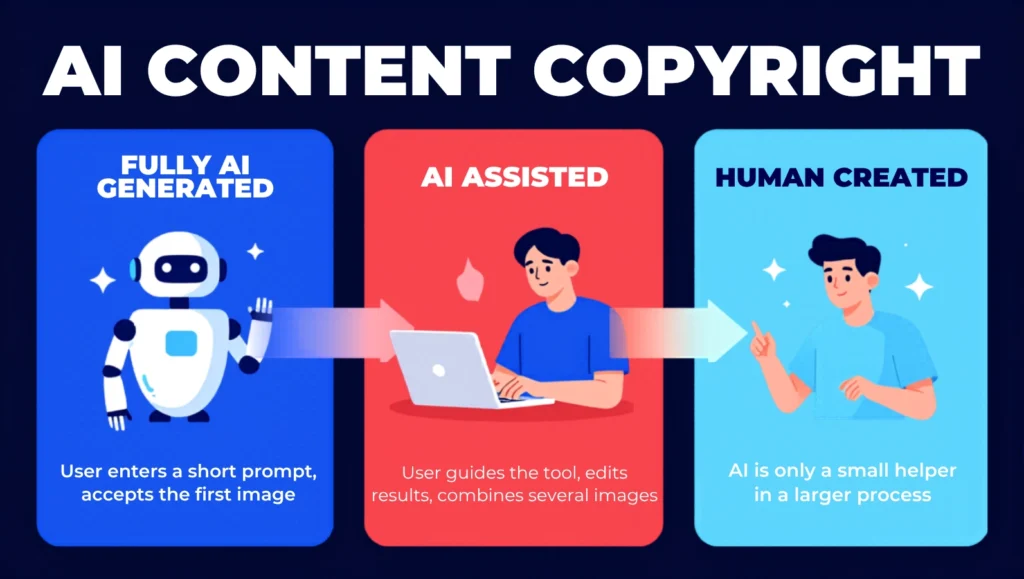
If a user types a short prompt and lets the AI system create a full image with no real human edits, many jurisdictions treat that image as uncopyrightable. According to the Copyright Alliance, purely AI generated works generally have no human author, so no copyright exists in the output at all, and they are treated like public domain material from a copyright point of view source.
In practice, that means:
However, there is another layer to consider. Even when copyright protection is absent, you may still hold distinct contractual rights. AI platforms utilize Terms of Service (ToS) agreements to grant or limit user permissions. It is vital to separate these two concepts:
For businesses utilizing generative images, it is highly recommended to audit an AI tool’s terms with a strict compliance checklist covering who may use the outputs, commercial rights allowances, sensitive use restrictions, and whether the provider can reuse your assets for future model training. Contractual rights cannot turn a non-copyrightable machine output into a copyrighted work, but they can legally dictate who can use the content and how, which is crucial for brand security.
For many clients asking who owns the copyright to ai art in real-life projects, the answer is often, “you own part of it.” Those are hybrid AI human works.
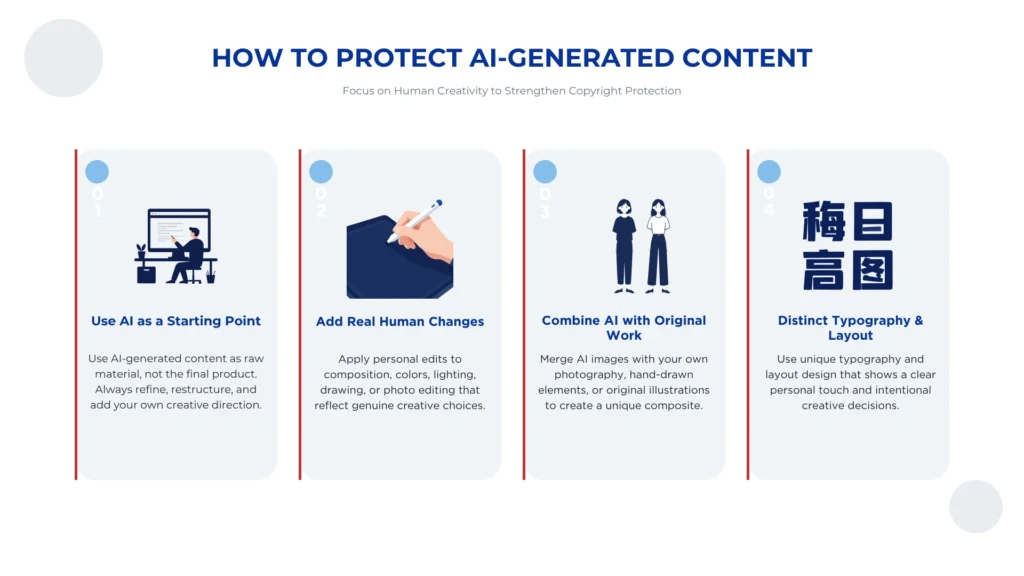
Hybrid ai and copyright situations happen when a human uses AI as one tool among many. That person makes creative decisions before, during, and after generation. In those projects, protection may exist in the human pieces, such as:
In these cases, ai generated content copyright usually covers only the human-authored layers, not the raw machine output. This split is confirmed by several legal analyses, which stress that human contributions can be protected on top of AI generated material (https://kavinoky.com/2025/01/ai-generated-images-copyright-ownership/). Navigating these complex boundaries requires a solid framework for managing AI and modern IP law.
Some simple examples help answer how the law views authorship in daily practice:
Minimal prompt only
Detailed prompt and iterative refinement
Heavy human editing
Collage or layout
Many people think ai and copyright means “the platform owns everything.” In most cases, that is not how the law works. AI companies usually own:
But as several legal commentators explain, owning the tool does not automatically mean owning copyright in every generated image (https://itsartlaw.org/art-law/artistic-or-artificial-ai/). Instead, ownership of outputs is set by a mix of:
Some platforms say, “you own the output where law allows,” while others grant themselves broad licenses to use or share your images. For a business making large campaigns with AI art, this becomes a core risk.
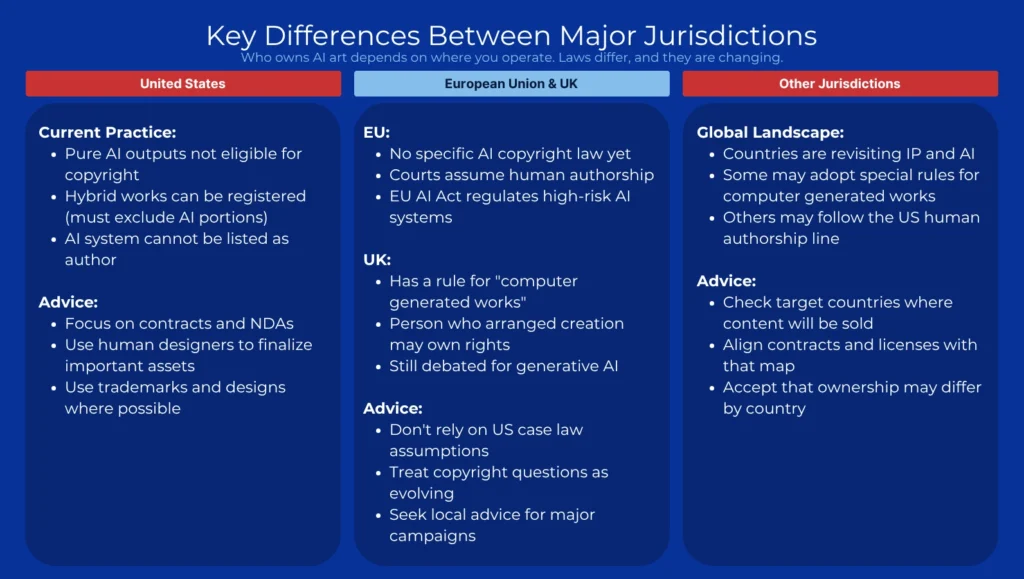
Who owns ai art also depends on where you operate. Laws differ, and they are changing.
In the United States, the human authorship rule is applied very strictly. The U.S. Copyright Office has made clear that it will not register works that are purely AI generated, with no human authorship (https://www.copyright.gov/ai/). Current practice in the US:
This means brands cannot rely on US copyright to keep purely AI generated images exclusive. For pure outputs, who owns ai art in the US is often “no one,” so anyone might reuse them. To manage risk and exclusivity, we advise US clients to focus on contracts and NDAs, use human designers to finalize important assets, and protect core identifiers by securing traditional trademarks.
In the EU, there is still no specific copyright law for AI authorship. Courts and regulators assume human authorship, and future cases will likely define standards for ai and copyright in more detail. At the same time, the EU is moving ahead with AI regulation more broadly, for example through the EU AI Act (Regulation (EU) 2024/1689, entered into force August 2024), which will affect how high-risk AI systems are built and used (https://www.europarl.europa.eu/topics/en/article/20230601STO93804/eu-ai-act-first-regulation-on-artificial-intelligence).
In the UK, the law is unusual. It has a rule for “computer generated works,” where the person who made the arrangements for creation can own rights (Copyright, Designs and Patents Act 1988, s. 9(3)). But there is still debate and uncertainty about how this applies to generative AI. For EU and UK businesses using AI art, our advice is:
Other countries are also revisiting intellectual property and AI. Some may adopt special rules for computer generated works, others may follow the US human authorship line. If your AI artwork is used in several markets, you should:
Using generative media introduces distinct compliance liabilities, particularly regarding how training models intersect with third-party intellectual property.
Because generative models are trained on massive datasets of existing images, they run the risk of outputting graphics that closely mimic protected characters, brand logos, or an artist’s distinctive style. For enterprise users, this means a generated asset could unintentionally spark a lawsuit for copyright infringement or unfair competition, even if your creative team was completely unaware of the original work.
Using pure AI to design a core brand logo is an incredibly risky strategy. If a pure machine output cannot secure copyright protection, you lose your primary legal weapon to stop competitors from copying your logo design. A far safer approach is to limit AI use to early mood boards and inspiration, ensuring a human designer manually reworks, vectorizes, and finalizes the asset to establish a clean chain of human authorship. Understanding the full landscape of intellectual property violations is essential to safeguard these visual assets from data leaks or copycats.
If you want real control over your images, you need to move beyond pure AI output.
To make ai generated content copyright protection more likely, focus on human creativity:
It is also important for clients to keep records, such as screenshots of prompts, intermediate results, layered source files, and notes on key artistic decisions. For digital projects, establishing a clear chain of authorship is as critical as securing your work through standard online copyright protection services.
Where law allows registration of hybrid works, such as in the United States, correct paperwork is vital. Basic tips:
Even in a world of AI, classic copyright registration still matters because it:
Where ai generated content copyright is weak, contracts become key tools. For businesses and agencies, this usually means:
For commercial clients and partners, strong contracts can include:
Before you publish or sell AI artwork in your business, ask:
Based on the Metida team’s experience advising EU businesses on copyright and brand protection, the most common practical gap is companies assuming that generating an AI image with a detailed prompt automatically creates enforceable rights. It does not.
If you are building brand assets or product visuals intended for exclusive commercial use, pairing AI generation with documented human creative input and a clear IP ownership clause in your design contracts is the minimum advisable practice under the current EU legal framework.
While internal guidelines are sufficient for daily social media posts, you should consult an IP professional when creating a new brand identity, launching a large-scale global product, or dealing with disputes regarding style mimicry or character likeness. For any IP rights help, you can contact the Metida team at your convenience via our contacts page.